
ThinkingCreative Practice
When the creative idea does the work
On clotheslines, shadows and the difference between an arresting image and a useful campaign concept.
In this piece
- An image attracts attention. An idea explains why it deserves it.
- The strongest metaphor has more than one useful life
- You cannot borrow emotion from the people in the frame
- The idea should help an audience see something differently
- Then make the concept pass five tests
- A second life on the website
- A concept is not an outcome
- Find the thing only this idea can say
A campaign can have a great photograph and no idea. It can also have a very good idea buried beneath too many slogans, formats and explanations.
The distinction matters most when the subject is difficult. A campaign about gender-based violence, for example, needs to attract attention without turning harm into spectacle. It must speak clearly enough to be recognised, carefully enough to respect those affected, and flexibly enough to work across different people and media.
In two consecutive editions of the global 16 Days of Activism against Gender-Based Violence, we approached that problem through two very different visual concepts.
In 2024, the campaign was #SadZnam, Now I Know. Clotheslines and laundry appeared in public spaces across Sarajevo. An object usually associated with domestic life became a way to challenge the expectation that violence should remain behind closed doors.
In 2025, #SadZnaš, Now You Know focused on digital violence. Shadows became its central motif: a way to express anonymity, the difficulty of seeing harm online and the consequences that remain after a screen goes dark.
They are linked campaigns, but their ideas are not interchangeable. That is what makes the comparison useful.
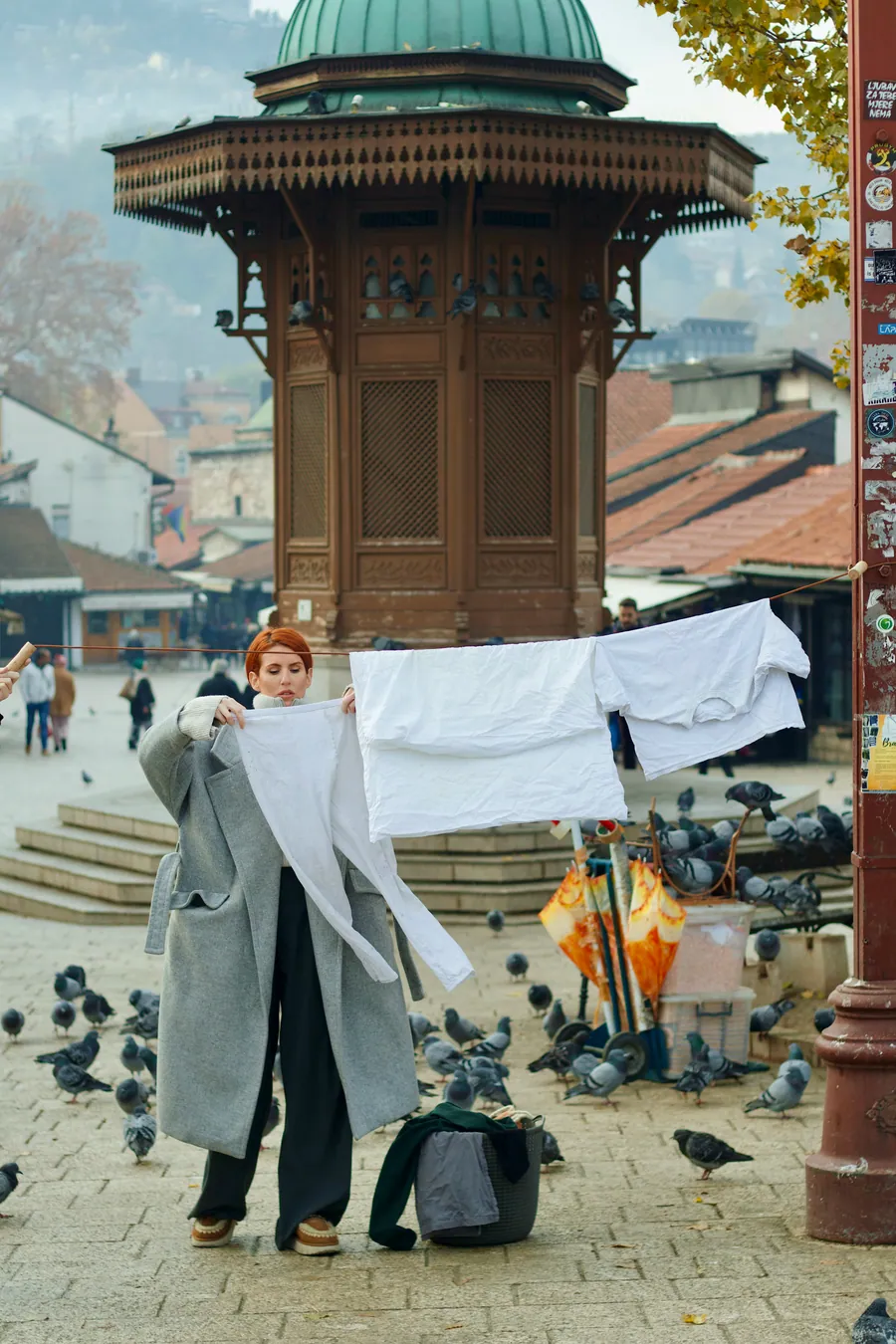
#SadZnam Now I know 2024
- The device
- Laundry on a line, in public space
- The movement
- Outward, from the home into the city
- The assumption
- That violence is a private matter, kept behind closed doors
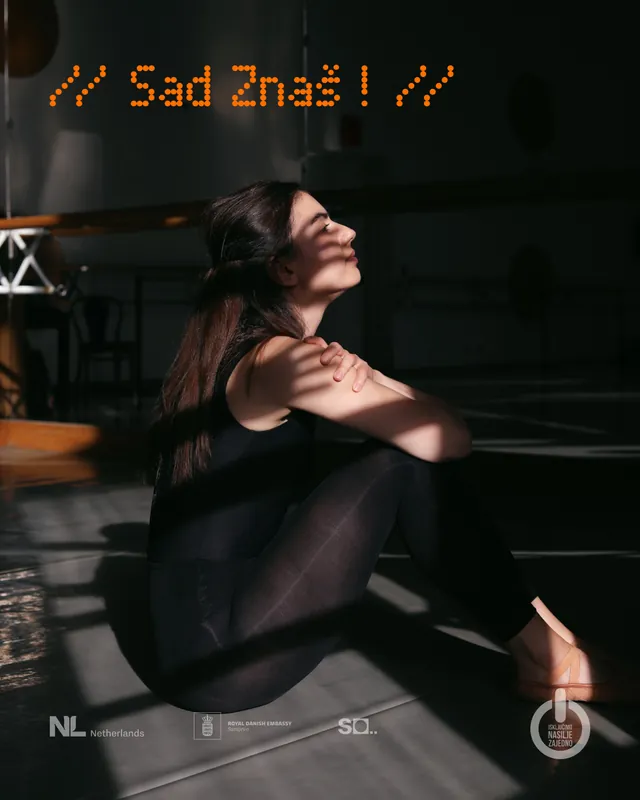
#SadZnaš Now you know 2025
- The device
- A shadow, present without revealing its source
- The movement
- Persisting, from digital space into lived experience
- The assumption
- That conduct behind a screen is separate from what happens to a person
An image attracts attention. An idea explains why it deserves it.
Imagine the first campaign without the clothesline: a group of people photographed around Sarajevo, accompanied by messages about gender-based violence. The subject would still be important. The photographs might still be striking. But what would hold the images together, and what would make them distinctive to the argument?
The clothesline answered both questions.
The familiar phrase about airing dirty laundry carries an expectation that difficult private matters should not be exposed. Put actual laundry in a busy public setting and the expectation is reversed. What is treated as private is brought into public view, where it belongs as a matter of shared responsibility.
There is an ordinary domestic object, an unexpected context and a recognisable social meaning. The idea lives in the relationship between all three.
That gives the image something to do before a caption is read.
In 2025, the setting changed. The campaign examined how violence in digital spaces affects people beyond the screen. A shadow is an unusually productive visual choice for this because it can be present without revealing its source. It can suggest concealment, extension and an effect that outlasts an action.
Again, the metaphor serves the subject. It creates a visual grammar for talking about online accountability without relying on screenshots of abusive messages or graphic depictions of harm.
Neither campaign needed the same visual treatment simply because the cause was related. The question was what the particular message required that year.
The strongest metaphor has more than one useful life
A campaign concept has to survive contact with production.
A beautiful art-direction sketch is not enough. The idea must work in photographs, short-form video, captions, original participant contributions and different placements. It must remain recognisable when viewed without sound or encountered for only a moment. It must tolerate variation without dissolving into a set of unrelated assets.
The 2024 line and basket of laundry created a repeatable visual situation. Different public locations and people could inhabit it while its meaning stayed legible. The campaign paired the photographic idea with conversational video content addressing issues such as warning signs, boundaries and the forms violence can take. Those conversations gave the broader campaign language and practical substance beyond its principal photographic metaphor.
The 2025 shadow worked differently. It provided a visual treatment that could travel between individual participants while keeping the campaign’s central claim intact. A range of people brought their own perspectives, but the handling of light, darkness and anonymity gave the work a recognisable identity.
This is what we mean when we say an idea can carry a campaign. It does not dictate every word or shot. It creates enough coherence for different contributions to belong together.
Coherence also helps production teams make decisions. Does a new format still communicate the central idea? Does the image need another explanation? Is the metaphor visible when the asset is cropped for a phone? If a piece has to carry every element of the brief on its own, the concept may not yet be doing enough work.
You cannot borrow emotion from the people in the frame
There is a temptation in cause-related communication to make every image solemn, dark or dramatically distressed. It is an easy shorthand for seriousness, and often a poor one.
A person taking part in a campaign is not a prop designed to establish the moral importance of the subject. Nor should a photograph imply that its subject has personally experienced violence unless that is genuinely their story and they have chosen to share it.
The distinction influenced how we think about these two bodies of work. The laundry and the shadow are symbolic devices. The participants remain people bringing perspectives to a public conversation, not characters assigned a private history by an art director.
A responsible idea leaves room for agency. It need not sensationalise suffering to be clear about harm. It can make space for knowledge, bystander responsibility, accountability and support.
This also matters for interactive design. An effect that would be playful in a commercial campaign may read very differently in work about violence. Making a visitor drag a threatening hand across a portrait, for example, would change the moral relationship between viewer and subject. The mere fact that an interaction is technically possible is not a reason to use it.
A good creative direction includes decisions about what the work must refuse to do.
The idea should help an audience see something differently
It is possible to describe almost any campaign with a statement such as raising awareness. The phrase does little to reveal the creative problem.
More useful questions are: Awareness of what assumption? What behaviour has become normal? What should the viewer be able to recognise after seeing this message that they might have missed before?
In #SadZnam, one assumption concerned the boundary between private trouble and public responsibility. The campaign used domestic objects in public space to challenge the instinct to keep violence unspoken.
In #SadZnaš, the assumption concerned distance: the belief that conduct behind a screen is somehow separate from what happens to a person in the world. The shadow offered a way to make consequence visible without depicting an incident literally.
These are not identical reframings. One moves a subject outward, from the home into the city. The other makes something apparently hidden persist, from digital space into lived experience.
Those differences gave each campaign its own form.
Then make the concept pass five tests
We don’t believe every campaign needs an elaborate manifesto. We do think a promising creative idea should survive a few difficult questions.
Can you recognise its point without reading the explanation? A viewer does not need to decode every layer, but the image should offer a meaningful first understanding.
Does it belong to this issue? Shadows, threads, bridges and mirrors are versatile metaphors. That is precisely why they are easy to apply lazily. The association has to reveal something specific, not simply look profound.
Can other voices enter it? A campaign about people becomes weaker when the visual system leaves no room for them. The concept should support participants’ contributions rather than reduce every person to the same pose and line.
Does it work where the audience will meet it? A photograph on a street, a vertical video on a phone and a printed graphic do not offer the same time, scale or attention. An idea needs a working life beyond the presentation deck.
What does it imply about the people involved? Good creative work is responsible for its suggestions as well as its explicit claims. Metaphor can make a difficult subject clearer, but it can also distort it.
No formula can replace judgment. These tests at least make the judgment discussable.
A second life on the website
When we later presented the two campaigns as case studies on the SO.. website, we made another creative decision: the portfolio experience should not be a generic gallery of finished posts.
For #SadZnam, the clothesline became an organising element across the page, connecting photographic encounters, campaign formats and the account of the work. For #SadZnaš, interactive light and persistent shadows made the campaign’s central metaphor something a visitor could experience while exploring the case.
These were new editorial interpretations for the portfolio, not features of the original 2024 or 2025 public campaigns. That difference is worth making explicit. We were not retroactively claiming that an online interaction had been part of the original delivery. We were using the same underlying ideas to explain the work in another medium.
That is a useful test of a concept’s depth. If it can travel to a new form without losing its meaning, it probably contains more than a single attractive image.
It also imposes restraint. The portfolio interaction should illuminate the work, not compete with it. The original participants and campaign material remain the evidence; the interface is a way of encountering that evidence.
A concept is not an outcome
We can speak confidently about what the two campaigns created: distinctive visual systems, published content and documented public distribution. Their reports also contain views, reach and interaction figures.
Those results show that the work was delivered and seen under the relevant platform measures. They do not, on their own, establish a change in the prevalence of violence, the safety of digital spaces or people’s long-term attitudes. Those questions require different evidence.
Separating creative quality, distribution and social outcome protects all three from exaggerated claims. A carefully made campaign can contribute to a public conversation without pretending that one set of posts has solved the problem it addresses.
The same principle applies to commercial briefs. A stronger identity is not the same as greater revenue. A compelling film is not the same as public understanding. The evidence needs to fit the result being claimed.
Find the thing only this idea can say
There is no shortage of ways to decorate a message. Animation, beautiful photography, strong type and sophisticated technology are all available. None can rescue a concept that has nothing particular to communicate.
The harder work happens earlier: recognising the assumption a campaign needs to challenge, finding a form that makes that assumption visible and testing whether the form remains meaningful when it travels across people and formats.
In one year, we brought laundry into the streets. In the next, we made shadows stand in for what persists beyond a screen.
The objects were different. The responsibility was the same: to make a difficult subject visible without simplifying the people whose lives it touches.
That is when a creative idea starts doing real work.